
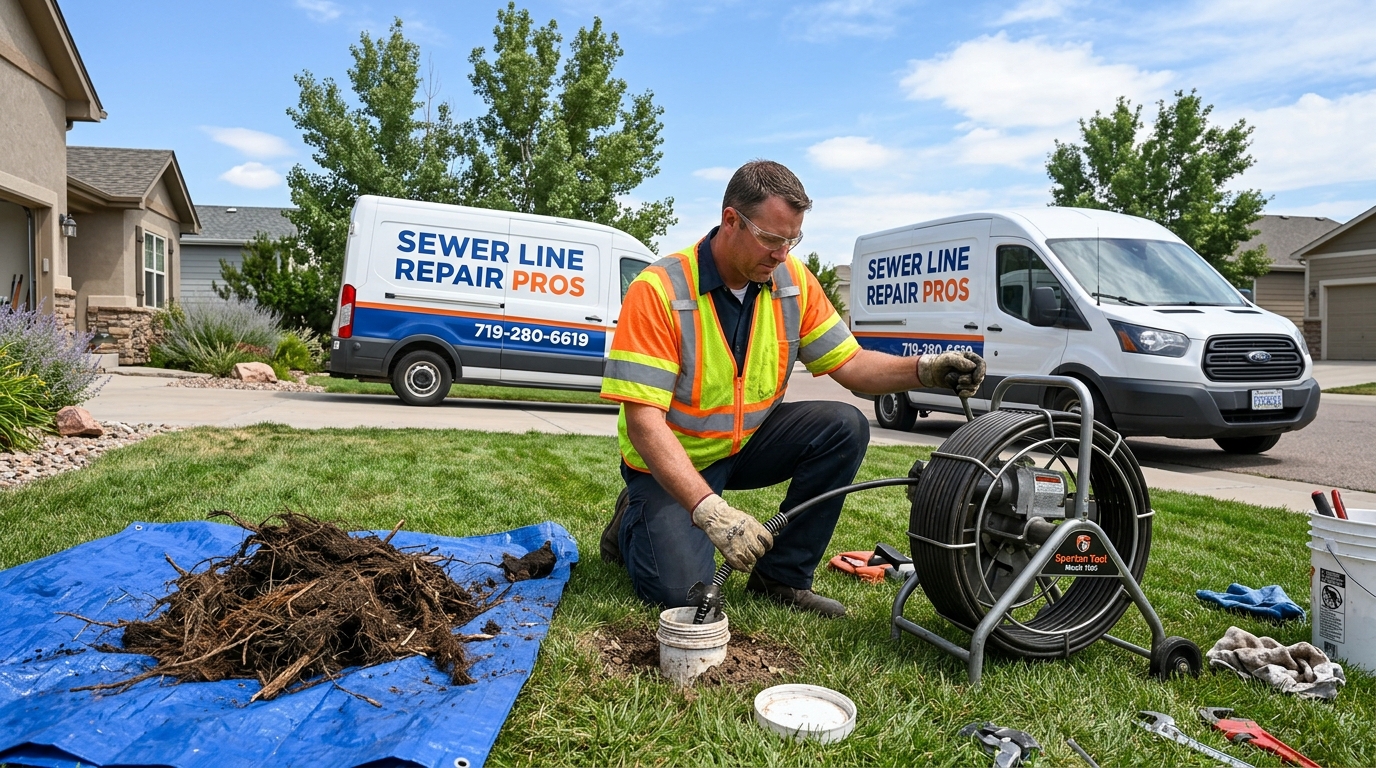
The Threat of Tree Root Intrusion in Pueblo West Sewer Lines
In Pueblo West and throughout southern Colorado’s semi-arid high desert, underground moisture is scarce. Rainfall averages less than 12 inches per year, creating an environment where shade trees like mature Plains cottonwoods, weeping willows, and fast-growing Siberian elms develop wide, aggressive root systems that travel up to three times their canopy width in search of water.
Beneath your yard, your residential sewer lateral is an underground oasis: warm, nutrient-rich water constantly flows through it. As Pueblo West’s expansive Pierre Shale bentonite clay soil swells and shrinks across annual weather cycles, rigid pipe joints loosen, separate, and develop hairline cracks. Water vapors escape into the dry surrounding soil, creating a subterranean scent trail that thirsty tree roots follow with relentless biological accuracy.
Microscopic hair-like root tendrils penetrate through these loosened joints. Once inside the moist, oxygenated pipe environment, the roots flourish. Within months, a hair-thin feeder root expands into a dense, interwoven wooden root ball that acts as an underground net, catching toilet paper, cooking fats, and flushed solids until your main sewer line completely chokes.
Signs Tree Roots Have Invaded Your Sewer Lateral
Tree root intrusion doesn't happen overnight—it is a progressive blockage that manifests in subtle warning signs before causing an all-out basement sewage flood. If you notice any of the following symptoms in your Pueblo West home, call our dispatch line at (719) 280-6619 immediately:
When sinks, tubs, and showers all drain sluggishly at the same time, the obstruction is in the primary lateral pipe rather than an isolated fixture trap.
Trapped sewer air forced around dense woody root obstructions bubbles up through standing trap water in nearby tubs or laundry basins.
Porous root intrusions leak nitrogen-rich sewage beneath the surface, acting as high-potency fertilizer that creates distinct emerald grass patches directly over your pipe path.
Rotting organic debris and hair ensnared in underground root masses emit foul hydrogen sulfide (rotten egg) gases that vent back into the dwelling.
Our 4-Stage Root Intrusion Removal & Permanent Eradication Process
Generic hand-crank snakes rented from hardware stores merely punch a tiny hole through soft clogs, leaving 90% of the wooden root mass untouched to regrow in weeks. At Sewer Line Repair Pros, we utilize an engineering-driven 4-stage protocol designed to physically saw roots away, flush the lateral clean, and permanently seal pipe joints against recurrence:
High-Definition Diagnostic Video Camera Inspection
We never feed high-torque blades blindly. Our self-leveling color camera travels the pipe from the exterior cleanout, verifying the exact depth, footage, and structural integrity of the host pipe. This guarantees we don't operate aggressive cutters in collapsed or fractured segments. Learn more on our camera inspection service page.
Commercial Mechanical Rooter Snaking with Rotary Saws
We feed heavy 3/4-inch inner-core steel cable driven by high-horsepower electric machines. Fitted with hardened steel C-cutters, spade blades, or expanding dual-blade root saws sized to your exact 4-inch or 6-inch pipe diameter, our rooter chews through solid wooden taproots, severing them flush at the pipe wall.
Hydro Jetting & Debris Scour Flush
Mechanical blades chop the roots, but wood chunks, hair, and grease remain behind. We deploy our 4,000 PSI commercial hydro jetter with rear-facing thrust nozzles to liquefy root shavings, blast off grease coatings, and flush all debris completely into the Pueblo West municipal sewer main. Explore our hydro jetting solutions.
Permanent Trenchless CIPP Epoxy Joint Relining
If roots entered your pipe once, they will return within a year through the unsealed joint. To provide a permanent 50-year warranty, we install a seamless Cured-In-Place Pipe (CIPP) epoxy liner inside the host pipe. This eliminates all open seams, creating a slick, continuous structural conduit that roots cannot penetrate. Review no-dig rehabilitation on our trenchless sewer repair page.
Comparing Sewer Root Removal & Eradication Methods
Different root invasion stages require tailored technological interventions. Below is our engineering comparison of available root clearing and prevention techniques:
| Method | Root Cutting Ability | Restores Diameter | Prevents Regrowth | Expected Longevity |
|---|---|---|---|---|
| Standard Hand Snake | Low (pokes hole only) | 20%–30% | No | 2 to 6 weeks |
| Commercial Rooter Saw | Very High (severs thick taproots) | 70%–85% | No (joint remains open) | 6 to 12 months |
| 4,000 PSI Hydro Jetting | Extreme (shaves roots to wall) | 100% | Temporary (needs sealing) | 12 to 24 months |
| Trenchless CIPP Epoxy Lining | Permanent Joint Sealing | 100% restored | 100% Root-Proof | 50+ Years |
Pueblo West Geological Reality: Pierre Shale & Tree Root Collusion
Homeowners across Pueblo West (ZIP 81007) face a unique geotechnical challenge: the interaction between expansive bentonite clay soil and invasive landscaping. Unlike stable sandy loam found in other states, Pueblo County soil swells violently when wet and forms deep shrinkage cracks during arid spells.
This perpetual ground movement pulls apart bell-and-spigot joints in vitrified clay pipes and shears older cast iron hubs. Once a joint opens even 1/16th of an inch, shade trees like native plains cottonwoods, honey locusts, and Russian olives seek out the moisture. Left untreated, expanding root wood can exert over 60 PSI of outward radial force—easily shattering the pipe hub and causing total structural pipe collapse.
Under Pueblo West Metropolitan District regulations, homeowners own their lateral all the way to the main collection sewer in the roadway. Regular rooter maintenance and prompt trenchless joint sealing protect you from catastrophic municipal excavation bills.
Frequently Asked Questions: Tree Root Removal & Rooter Services
Chemical root treatments only kill thin root hairs that touch the water level at the bottom of the pipe. They cannot penetrate large, dense root canopies hanging from the top of the pipe, nor can they dissolve heavy wood pulp. Mechanical rooter blades or hydro jetting are required to physically excise the mass first.
Our licensed technicians always select blade diameters and cable flex calibrated to your pipe's material and condition. We perform a preliminary video camera scan to verify pipe stability before operating high-torque cutters, preventing damage to fragile clay or cast iron.
A standard rooter clearing with initial camera scoping and thorough line testing typically takes between 60 and 90 minutes. If paired with high-pressure hydro jetting for complete wall scouring, allow approximately 2 to 2.5 hours.
In almost all cases, no! Removing a mature shade tree in Pueblo West is expensive and diminishes property value. Instead of destroying your tree, we install a seamless CIPP trenchless pipe liner inside your sewer lateral. This creates a solid, joint-free epoxy barrier that roots cannot breach, allowing you to preserve your trees with complete peace of mind.
Yes. If raw sewage is backing up through basement floor drains or toilets due to an acute root clog, call (719) 280-6619 for immediate emergency rooter dispatch across Pueblo West and surrounding communities.
Don't wait until invasive tree roots cause sewage to flood your basement. Call our Pueblo West team now at (719) 280-6619 or request a rapid-response estimate through our Contact Form.